
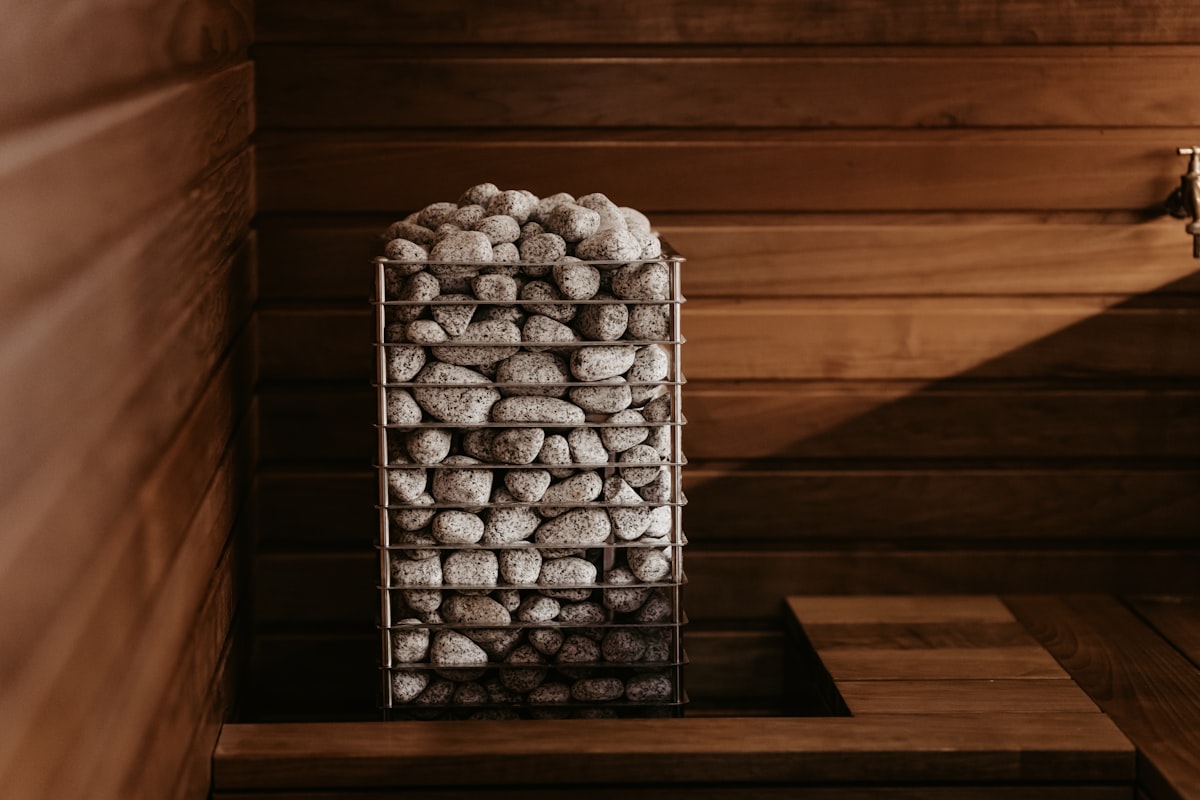
How to Choose the Right Sauna Rocks
Not all rocks belong in a sauna. Here are the stones to use, the ones to avoid, how much rock your heater needs, and when to replace it.
Sauna rocks do one job: absorb heat from the heater and release it as löyly when water hits them. The wrong stones can crack, crumble and clog a heater. The right ones give smooth, steady steam for years. Here is what to look for, what to avoid, and how much your heater actually needs.
What makes a good sauna rock
A good sauna stone is dense and dark, and it can heat up and cool down again and again without cracking or crumbling. It should also be tested so that it gives off nothing when hot. Harvia, for example, has its stones tested by the Geological Survey of Finland. That is a big reason to buy stones sold for saunas rather than gather your own.
The best options
- Peridotite — The rock Misa uses in its wood-burning stoves, and the one we offer through Finnport as Misa's 25 kg box. Very dense, and it handles the hard temperature swings of a wood-fired stove. Harvia's heater manuals also list peridotite as a suitable stone. If you have a Misa stove, it is the natural choice for replacements.
- Olivine diabase (olivine dolerite) — Harvia calls it the most traditional sauna stone and says it suits every type of heater. Dense, dark, and resistant to thermal shock.
- Vulcanite and other volcanic stones — Harvia's black vulcanite is hard and durable and works in all heaters. Volcanic rock varies a lot, though: some is dense, some is full of tiny gas pockets. Stick to stones sold for sauna use.
- Rounded stones for the top layer — Rounded olivine diabase gives a slightly softer steam. It goes on top, with angular stones underneath. Some heaters, such as Harvia's Spirit, are designed around round stones, so check your manual.
There is a local connection. The flat-topped Nor'Wester Mountains south of Thunder Bay, including Mount McKay, are capped by a diabase sill about 60 metres thick, formed roughly 1.1 billion years ago when the Midcontinent Rift tore open the Lake Superior region. Diabase is the same family of rock that Finnish makers quarry for sauna stones. The 16 kg boxes we offer through Finnport are igneous bedrock from Northwestern Ontario.
What to avoid
- Soapstone in the stone pile — It is often praised for soft steam, but it is soft stone, and Harvia's manual says soft soapstone should not be used as heater stones. It works well as cladding on a heater, which is how Tulikivi uses it.
- Granite as your main stone — Granite is a mix of minerals that expand at different rates when heated, and it can crack. Harvia sells white and red granite only as a decorative top layer, and no more than one box per heater.
- Stones from nature — River stones and field stones can hold moisture and crack, and some types contain things you don't want in hot air. Harvia says plainly not to collect stones from nature.
- Sandstone, limestone and other layered rocks — They split and crumble under heat.
- Light, porous ceramic "stones" — Harvia's manual says not to use them either.
- Any stone that is crumbling — Grit and fragments can pack into an electric heater and block airflow, which can overheat the elements.
How much rock does your heater need?
It depends on the heater's design, not just its kilowatts. A tower-style heater holds far more rock than a wall-mounted one of similar power, and the maker's number is the one to follow. Too few stones and the heater works hard for poor steam. Too many and they block airflow and can overheat the elements.
Heaters we carry:
- Fenno W1-6 and W1-9 wall-mounted (6 and 9 kW) — about 35 lb (16 kg). One 16 kg box is the right amount.
- Fenno D1-6 floor model (6 kW) — about 50 lb (22.7 kg). That is one 16 kg box plus about half of a second.
- Homecraft Revive Slim — up to 100 lb (45 kg), roughly three 16 kg boxes.
- Homecraft Revive — about 175 lb (79 kg), roughly five 16 kg boxes.
- Homecraft Apex Mini — about 175 lb (79 kg).
- Homecraft Apex — about 310 lb (140 kg). That is nearly nine 16 kg boxes, so plan ahead.
Smaller heaters need much less. Some compact wall-mounted heaters on the market hold only 15 to 20 kg, and a small heater of around 4.5 kW may need less than a full box, so check its manual.
Wood-burning stoves vary even more. Misa's 11108 holds about 28 kg, the 11407 about 90 kg, and the Kiviset 11220 and the HEV1 each about 200 kg. For those, Misa's 25 kg peridotite box is the stone to buy.
Size matters too. Electric heaters usually want stones around 5 to 10 cm so they fit between the elements. Wood-burning stoves usually take larger stones, around 10 to 15 cm. Your manual lists the size and the amount.
When you load an electric heater, set the stones in loosely so air can move between them. Keep the elements covered, but never wedge stones between the elements, never let the weight of the pile rest on them, and don't build a high heap above the frame.
When to replace them
Harvia says to take the stones out and re-stack them at least once a year, and more often with heavy use. If the heater is used about twice a week, that means fresh stones about once a year. That is roughly 100 sessions, and it is a good rule of thumb for any heater. HUUM counts in hours: inspect the stones at 100 hours, re-stack and swap broken ones at 200, and replace them all at around 400. Stones that are old but still sound can stay. Condition matters more than age.
Signs that it is time:
- Stones are crumbling, breaking apart or discoloured
- Stone dust and fragments are collecting under the heater
- Two stones knocked together sound dull and shallow instead of giving a crisp click
- The steam is weaker, or the sauna takes longer to reach temperature
When you re-stack, let the heater cool, remove all the stones, clear out the debris, and wash the stones and let them dry before loading them again. Replace any that are cracked.
Not sure how much your heater needs? Tell us the model when you get in touch or visit us at 290 Bay Street, Thunder Bay.