There is a word in Finnish that has no direct translation. It refers to the steam that rises when water meets hot sauna stones — but it means something more than that. Understanding löyly is understanding why Finnish sauna is different from every other hot room in the world.
A Word That Contains a World
Löyly (roughly "LOW-loo") has been part of the Finnish language for thousands of years. Linguists trace it to Proto-Uralic roots meaning breath, spirit, or the animating force of a living thing. In old Finnish folk belief, löyly was the life force of the sauna itself — something present and alive, not merely a byproduct of physics.
The word is used today in a purely practical sense — "throw some löyly" means ladle water onto the stones — but that older meaning hasn't entirely disappeared. Ask a Finnish person why their sauna feels different from one they've tried abroad, and the answer almost always comes back to löyly. Not the temperature, not the wood, not the stove. The steam.
What Actually Happens When Water Hits the Stones
The physics is simple. Sauna stones are heated to 200–300°C at their surface — far above the boiling point of water. When you ladle water onto them, it flash-vaporises almost instantly, expanding into steam that fills the room. Humidity spikes from under 10% to 30–40% in a matter of seconds. The perceived heat rises sharply.
What makes this more than a humidity reading is how it feels on the body. The sudden wave of moist heat often makes breathing feel easier and deeper, and makes the heat feel enveloping rather than sharp. A sauna without any löyly — purely dry heat — has a particular quality, not unpleasant, but thinner somehow. The same room with good löyly feels more alive.
The steam passes in 60–90 seconds as it cools and disperses. Then the room settles back to its drier baseline, and you wait, breathing slowly, until you're ready to throw another ladle.
The Skill of Throwing Löyly
This is where sauna culture becomes craft.
How much water, how often, from what height, at what angle — experienced bathers develop intuitions about all of it. A small ladleful thrown slowly from close to the stones produces a soft, even steam. A larger pour from height produces an intense, sharp burst. Some people add a few drops of birch tar, pine, eucalyptus, or tar oil to the water — the steam carries the scent through the room and into the lungs, which is quite different from smelling it from a bottle.
In Finnish sauna culture there is usually one person responsible for the löyly during a session — often the most experienced person in the sauna, or the one sitting highest and closest to the stove. They read the room. If someone is struggling with the heat, the ladles come less frequently. If everyone is settled and quiet, another round goes on. It is an act of attentiveness as much as anything else.
The Finnish concept of sopiva löyly — just the right steam — is considered an art. Too little and the sauna feels flat. Too much, too fast, and the heat can become overwhelming rather than enjoyable. The right löyly builds gradually over the session, each round slightly deeper than the last.
Stones Matter More Than You Think
The quality of löyly depends heavily on the stones. Dense, non-porous rocks — olivine diabase is the Finnish standard — absorb and hold heat through their full mass, not just at the surface. When water hits them, they release that stored energy into the steam rather than losing it immediately. The result is a softer, longer-lasting steam.
Rocks that are too small, too porous, or simply old and degraded produce a harsher, shorter-lived burst that dissipates before it fully develops. Finnish sauna owners replace their stones every few years for this reason — not because they look worn, but because the löyly tells you when they no longer perform.
Properly arranged stones help maintain more even heat and steam production. Most traditional Finnish sauna stoves are designed with a deep stone bed, so that water thrown on the upper layers passes through several layers of heated stone before converting to steam — which produces a more complex, rounded steam than a shallow stone bed would.
What Löyly Is Not
Visiting a sauna abroad — whether a hotel steam room, a spa "Finnish sauna," or a gym dry sauna — usually produces the same quiet disappointment in Finnish people. The temperature might be right. The wood might be real. But the löyly is wrong, or absent.
Steam rooms, for instance, produce continuous humidity rather than the alternating waves that define the Finnish experience. The rhythm is gone. Infrared saunas produce radiant heat with no stones at all — genuinely different in how it feels. Neither is bad; they're simply different things.
What makes löyly distinctive is precisely the cycle: dry heat, then steam, then the gradual return to dry. Your body responds to that change. The contrast is what makes you breathe deeply, what makes the rounds feel distinct from each other, what makes you aware of where you are and what you're doing. It requires attention — you can't fall asleep through good löyly the way you might in a steam room.
The Ritual of the Ladle
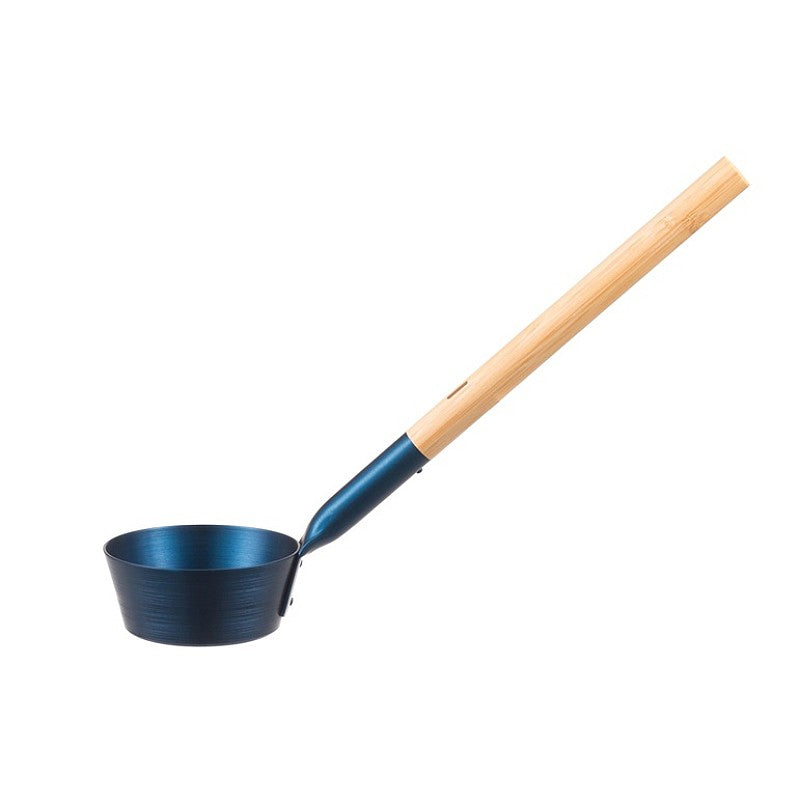
The wooden ladle — kauha in Finnish — is one of the most considered objects in Finnish material culture. It should be long enough to reach the stones comfortably without putting your face near the heat. Wide enough to carry a useful amount of water without being cumbersome. Made from a wood that won't burn your hand when the steam rises back across it.
The bucket beside it holds cool water. Some bathers occasionally add a small amount of beer for its distinctive aroma — the tradition is old enough that no one is entirely certain where it started. More commonly, a few drops of birch, pine, or tar oil go into the water, scenting each round of steam differently through the session.
Together, the bucket and ladle are as fundamental to Finnish sauna as the stove itself. They are not accessories. They are how the sauna breathes.
Why It Matters
There are plenty of ways to get hot. The thing that Finnish sauna culture has preserved, and that löyly represents, is a specific relationship between the person in the sauna and the heat they're sitting in. You're not a passive recipient of a set temperature. You're managing the environment, round by round, responding to how you feel and how the people around you feel.
That active quality — the small ritual of reading the room, picking up the ladle, throwing a careful measure of water, and listening to the steam rise — is what turns a hot room into something worth doing slowly. Worth doing repeatedly. Worth doing with people you want to sit quietly with.
The steam itself lasts less than two minutes. The feeling it produces can carry an entire evening.