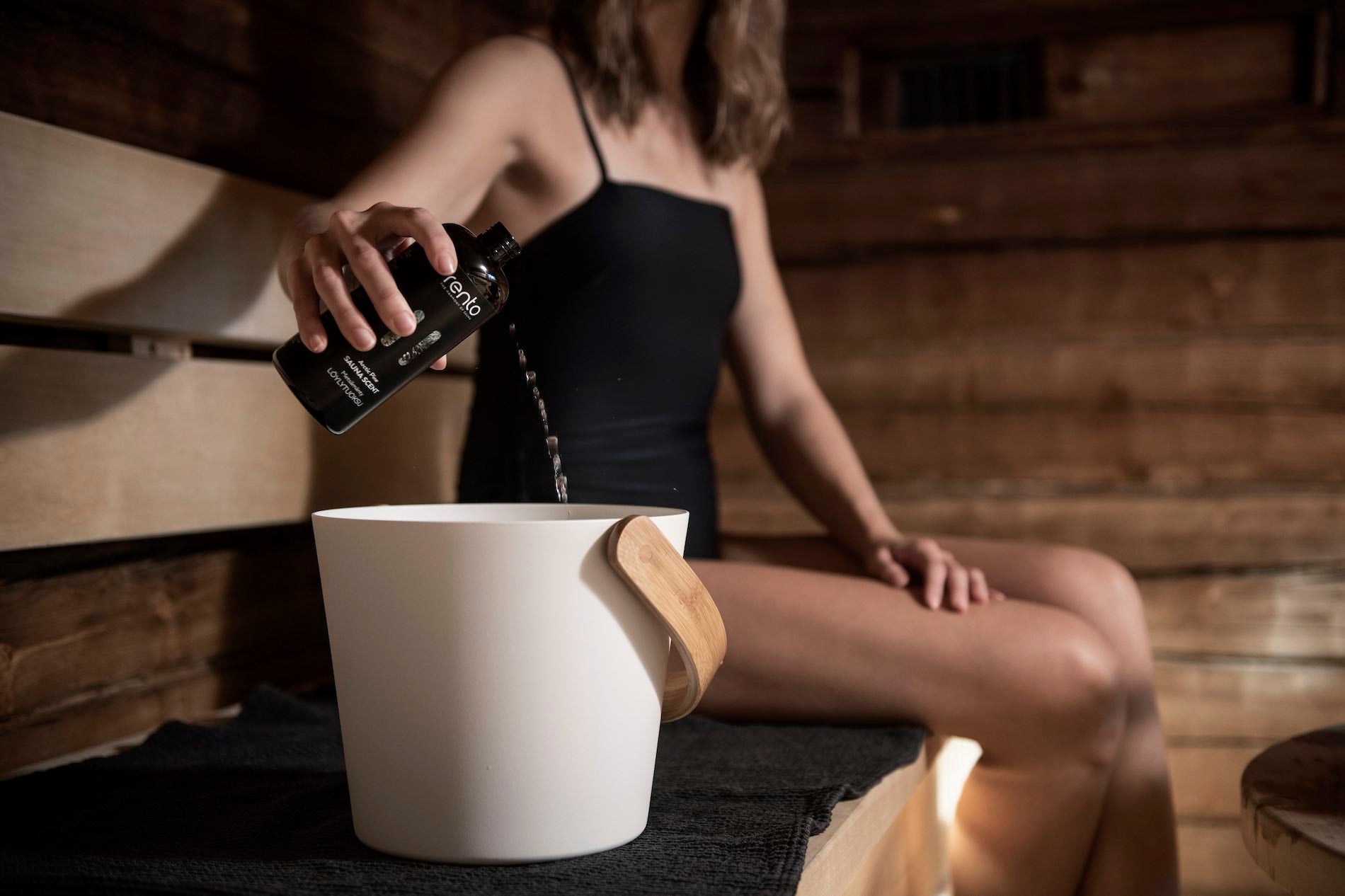
There is a moment, perhaps twenty minutes after you have settled onto the bench of a well-fired smoke sauna, when the heat stops being something that happens to you and becomes something you are inside of. The air has a weight and a softness that few other saunas can produce. The walls are black. The stones glow faintly in the near-dark. You pour a ladleful of water and the steam rises without violence — a long exhalation rather than a hiss — and settles around you. This is one of the oldest heated rooms in continuous human use.
Rooted in the North
The smoke sauna, or savusauna, is widely regarded as the oldest and most traditional form of Finnish sauna, from which later sauna types evolved. Every other form — chimney-heated, continuously-fired, infrared — represents a later adaptation, emphasising convenience, efficiency, or accessibility. To build a savusauna is to understand what was there first.
Archaeological evidence suggests that heated pit shelters and sweat-bathing traditions in northern regions date back thousands of years, though direct links to Finnish sauna practice are difficult to prove. What is certain is that in Finland the sauna predates written history. The word appears in documents from the thirteenth century, but the practice is older than any record. The earliest structures were pit dwellings: a hole in the earth, lined with stone, covered with hides or turf, heated with fire-warmed rocks. Smoke had no chimney to escape through. It filled the space, hung at the ceiling, and eventually found its way out through whatever gap the builder had left. The room blackened. The stones held heat for hours. People bathed, gave birth, dressed wounds, and prepared the dead in the same warm building.
The smoke sauna was the warmest, cleanest room a northern family possessed. The heat killed pathogens. The dry soot layer helped keep the wood dry and contributed to the sauna's distinctive aroma. Finnish women traditionally gave birth in the sauna not from superstition but from practical knowledge: it was the safest room in the house.
In December 2020, UNESCO added Finnish sauna culture to its list of Intangible Cultural Heritage of Humanity. The savusauna is widely regarded in Finland as the ancestral form. There are an estimated three million saunas in Finland for a country of five and a half million people, but only a few thousand smoke saunas remain in active use. The people who build new ones are preserving a tradition that survives through continued practice and knowledge passed between generations.
What Makes It Different
A smoke sauna has no chimney. Everything else follows from that.
When you fire a savusauna, smoke from the burning wood fills the entire room. It settles on the walls, ceiling, benches, and stones. It heats the mass of the building from the inside out. Over four to six hours of steady firing, the stones — which in a well-built smoke sauna will weigh between 200 and 500 kilograms — absorb an enormous quantity of heat. The smoke-darkened wood and large thermal mass create a gentler, more even heat than most continuously heated saunas.
Before anyone enters, the fire is allowed to burn down completely and the damper, a simple wooden or metal hatch usually in the floor or lower wall, is opened to vent the smoke. This takes 30 to 60 minutes. When the air is clear, the damper is closed, the door is shut, and the residual heat in the stones and walls maintains a bathing temperature for four to eight hours. A modern continuously-heated sauna drops from bathing temperature as soon as the heater is off. A smoke sauna does not.
The löyly, the steam produced when water is thrown on the stones, is recognisably different from that of any other sauna. The difference has a physical explanation. In a smoke sauna, the stones have been heated slowly and evenly over many hours. They are hot all the way through, not just at the surface. When water contacts them, the steam production is long and sustained rather than sharp and brief. The ambient air, having been heated slowly alongside the walls and ceiling, holds more moisture at equilibrium than the air in a freshly heated sauna. The result is a heat that envelops rather than strikes. Old Finnish bath-goers call it pehmeä löyly, soft steam, and once experienced the comparison to other saunas becomes beside the point. They are different things.
The soot on the walls is not a side effect to be managed. It is a feature. New smoke saunas require several curing fires before use, allowing residues from early firings to stabilise. Over time, the dry soot layer protects the wood, contributes to the sauna's distinctive clean aroma, and helps keep the interior dry in a way that paint or sealant cannot replicate.
Principles Before Plans
Before any budget conversation, before any choice of timber or stone, four principles govern every smoke sauna design.
Site and water. A smoke sauna is built near water. This is not aesthetic preference; it is functional necessity. The cooling rounds between bathing periods — swimming, rolling in snow, pouring cold water over yourself — are as important as the heat itself. A lakeside site 20 to 40 metres from the water is ideal: close enough to reach quickly, far enough that seasonal flooding is not a concern and the building can drain freely.
Orientation. Orient the door away from prevailing winds if possible. Cold wind across the door during firing makes it harder to maintain a good draw and increases smoke spillage. On a calm day this matters less; on a windy one, it matters considerably.
Thermal mass. Everything in a smoke sauna is about storing heat. The logs, the stones, the floor — all of it acts as a thermal battery. More mass means longer heat retention and more stable temperatures. This is why a smoke sauna fired for four hours in the morning can still be used comfortably at nine in the evening. Design for mass; do not reduce it to save cost.
Ventilation. The low fresh-air inlet is a small hatch in the lower wall near the door. It supplies combustion air to the fire during heating, allows controlled smoke venting once the fire has died down, and provides a trickle of fresh air during bathing. Its placement matters: too high and it fails as a combustion air source; too large and it bleeds heat. A traditional size is roughly 20 by 30 centimetres, with a tight-fitting wooden cover.
The Budget Build: $2,000–$6,000
A functional smoke sauna can be built for under $6,000 if you are willing to do most of the work yourself and make intelligent compromises. There are places to save money and places where cutting corners means building something that will not work properly or is unsafe.
The structure can be built from reclaimed logs or rough-sawn timber. Old log barn wood is ideal if you can source it: it is already seasoned, often dense, and is already cut to usable sizes. Fresh-cut timber will work but requires more time for settling and will need re-checking of gaps and chinking in the first two years. The interior footprint for a usable smoke sauna is modest: 2.5 by 3.5 metres is comfortable for three or four bathers. Do not build larger on a tight budget. A bigger room requires more stone and more firing time to reach the same temperature.
The stone pile, or kiuas, is where you must not compromise. Field stones are free if you live in the right landscape, but not all stone works. More on stone selection below. On a tight budget, collect and sort stones yourself — it costs nothing but time. Aim for 200 kilograms minimum. A well-arranged unmortared pile, with the largest stones at the base and the fire chamber formed in the space between them, will outlast a carelessly mortared structure. No mortar at all is better than the wrong mortar.
The floor can be earthen or compacted gravel with removable wooden duckboards. The door should be solid wood, not hollow-core, and hung carefully for a good seal. A poor door seal is the most common reason budget smoke sauna builds fail to reach temperature.
Do not compromise on: a CO detector rated for sauna conditions, stone quality, door seal, or wall thickness. Walls under 150mm cannot hold enough heat. Everything else is negotiable. A competent person working most weekends can complete the structure in one summer, with two additional months of curing fires before first use.
The Mid-Range Build: $15,000–$45,000
In this range you can build something that will last a century with almost no maintenance. The difference from the budget build is not luxury — it is craft and permanence.
Log construction at this level uses dovetail or saddle-notch joinery cut by someone who knows the work. The corners are tight, the logs seasoned before assembly or cut from standing-dead timber, and the chinking done with traditional moss or hemp rather than silicone. Traditional joinery holds over decades in ways that modern sealants do not. The building moves as a single unit rather than fighting its own expansion and contraction.
The stone mass can be purpose-built: a steel frame, lined with firebrick at the firebox and stacked with 300 to 400 kilograms of olivine diabase or similar stone above. A well-built unmortared pile with correct stone will perform comparably, but a purpose-built mass is more reliable over decades and easier to maintain.
At this budget you can also have a proper drainage floor: wooden planks set slightly above grade with gaps over a gravel sub-base, so wash water drains freely. A cast iron or heavy steel damper plate will outlast the building.
Whether to hire a builder depends on your skills. Saddle-notch log construction is learnable, but a first-time builder working alone will make errors that cost more to fix than hiring an experienced craftsman from the start. If you hire, confirm that your builder has built smoke saunas specifically. A general log builder unfamiliar with smoke dynamics and thermal mass requirements can produce a beautiful building that heats poorly.
The Unlimited Build
A larger budget does not automatically produce a better smoke sauna. The difference between a $45,000 build and a $150,000 one is mostly aesthetic and material quality, not bathing performance. A carefully built mid-range savusauna with correct stone and tight log walls will bathe very similarly to one built with old-growth pine and bespoke joinery. What money buys at the top end is longevity, beauty, and the accumulation of traditional craft in every joint and surface.
Old-growth Scots pine, slow-grown and dense with tight annual rings, is a different material from plantation timber. It will not twist or check in the first years. It holds heat better and resists moisture more effectively. Sourcing it requires relationships with sawyers in Scandinavia or Finland, where a small number of operations still mill certified old-growth salvage. Expect lead times and prices two to four times that of standard timber.
A master log builder working in traditional Finnish joinery — there are a handful in Finland and a few more in Canada and the northern United States — produces work that shows in the surfaces: adze marks, hand-cut notches, the way the logs settle over years into something that looks as if it grew from the site.
At this level, the smoke sauna is typically part of a larger complex: a washroom where bathing happens, a proper changing room, a lakeside platform. These additions make the ritual more complete. But they are not what determines the quality of the löyly. The peasant's smoke sauna with 300 kilograms of correct stone in heavy pine walls produces steam as good as the architect's. Keep that in mind when writing the cheque.
The Stones
Stone selection is the most consequential technical decision in smoke sauna construction, and the one most often made carelessly.
Not all rock withstands the thermal cycling of a smoke sauna kiuas. Granite, the most commonly available field stone across much of the northern hemisphere, is problematic. It contains quartz, which undergoes a structural phase transition at 573 degrees Celsius, expanding suddenly and sometimes violently. Granite in a kiuas will crack, pop, and occasionally explode. This is dangerous and produces sharp fragments that damage adjacent stones and can destabilise the pile over time.
The best stones for a smoke sauna are olivine diabase and peridotite: dense, dark, fine-grained rocks with high iron and magnesium content and no quartz. They handle thermal cycling without structural damage, hold heat well, and produce good steam. In Finland and Scandinavia these are sold commercially by kiuas suppliers. In North America, source from a specialty supplier; the cost is worth it. Basalt and andesite are acceptable alternatives. River-rounded stones of any suitable type are preferable to angular fragments, as they fit together more stably and have less surface area subject to thermal stress.
For a sauna interior of 8 to 10 square metres, plan on 200 to 250 kilograms as an absolute minimum. Three hundred is better. Four hundred is excellent. Undersizing the stone mass is the most common reason smoke saunas fail to hold temperature through a long session. Arrange stones with the largest, flattest pieces at the base forming a stable platform, the fire chamber opening at the front, and the remaining mass stacked as densely as possible. Minimise air gaps; you want mass, not airspace.
Curing and Seasoning
A new smoke sauna cannot be used immediately. The soot must build up gradually, the wood must dry out, and the stone pile must be thermally cycled before it can handle a full firing.
Plan for ten to fifteen curing fires before your first bathing session. Start small: a handful of kindling, a few pieces of split wood, burning for one to two hours. The goal is not heat but moisture removal from the wood and stones, and the beginning of soot deposition on the walls and ceiling. Increase fire size gradually across sessions. By the fifth or sixth, you should be burning for two to three hours.
Watch the stones. Cracking or popping in the first few firings suggests a problematic stone in the pile; remove and replace it. Watch the log walls for unexpected gaps or checks that might allow smoke to bypass the intended ventilation path. Every smoke sauna is slightly different — its draw characteristics, how smoke distributes inside, how the damper behaves. You learn this through the curing fires. After ten to fifteen, the walls will be lightly blackened and the pile settled. Then you are ready.
How to Fire It
Allow four to six hours between lighting the fire and entering the sauna. Many experienced users prefer six to seven for a long evening session. The stone mass needs that time; there is no shortcut.
Start with dry birch kindling. Birch burns hot, produces relatively clean combustion, and generates manageable smoke during startup. Once the fire is established, add larger split logs. Aim for a steady, medium-hot fire: not a roaring blaze that risks overheating the stones, not a smouldering crawl that fails to transfer heat efficiently. Feed it every 30 to 45 minutes.
Watch the smoke inside the sauna. Grey smoke with movement indicates good combustion. Heavy, slow smoke signals incomplete burning. Add wood before the fire drops too low; a fire that dies and must be restarted loses an hour of heating time.
About 45 minutes before venting, stop adding wood and let the fire burn down to coals. When the fire has died down to embers and no active flame remains, it is time to begin venting.
Venting the Smoke
Open the low fresh-air inlet and any other ventilation openings. If your sauna has a smoke hatch in the ceiling or upper wall, open it. Leave the door open. Warm smoke rises, fresh air enters from below, and the room clears from the top down. In a well-designed sauna this takes 30 to 60 minutes.
Do not rush it. Carbon monoxide is colourless and odourless and is the real danger in smoke sauna use. A person can lose consciousness without warning at moderate concentrations. Use a CO detector rated for sauna conditions and install it according to the manufacturer's specifications — standard household CO detectors may not be rated for sauna temperatures and humidity. It must read clear before anyone enters. It is the single most important safety practice.
The traditional test for smoke clearance is to hold a white cloth near the ceiling and check for discolouration. This is useful as a field check but does not detect CO. Use the detector regardless of what the cloth tells you.
When the smoke is cleared and the detector confirms it, close all ventilation openings, shut the door, and let the sauna stabilise for ten to fifteen minutes. The temperature at bench height is typically between 60 and 80 degrees Celsius, though some are fired hotter depending on tradition and preference. The high humidity makes it feel at least as intense as a hotter dry sauna.
The Ritual of Bathing
The smoke sauna is not a place you visit for twenty minutes. It structures an afternoon or evening and asks to be approached accordingly.
The first round is usually unhurried: ten to fifteen minutes on the bench, the body adjusting to the heat. Pour water on the stones sparingly at first. A single ladleful produces a long, sustained wave of steam that travels across the bench and wraps around everyone present. Too much water too soon exhausts the heat stored in the stone surfaces. Give the stones time to recover between pours.
The birch vihta, called vasta in eastern Finland, is a bundle of fresh or reconstituted birch branches used to gently beat the skin. The action is not aggressive — more like slow, rhythmic pressure that opens the pores, stimulates circulation, and releases the volatile compounds of the birch leaves into the steam. A vihta made from branches cut just after the leaves have fully opened in early summer, then frozen or dried, is indistinguishable from fresh.
Between rounds, cool in the lake. In winter, roll in snow or pour cold water from a bucket. For many bathers this cooling is an essential part of the experience. The contrast between heat and cold leaves people feeling deeply relaxed and restored, a calm that often lasts for hours afterward.
Three rounds is a common structure. Some people do more. The sauna is ready when you are satisfied, not when a timer goes off.
Safety
Carbon monoxide is the primary risk. Everything else is manageable with common sense.
Use a CO detector rated for sauna conditions and install it according to the manufacturer's guidance. Check the battery before every firing season. Replace the unit on schedule regardless of apparent function. Never enter the sauna until it reads clear. Never make an exception to this rule.
Keep a bucket of water inside the sauna room during firing. The stone pile and fire chamber can shift; a loose stone falling against a wood surface is rare but possible, and a bucket immediately available is the correct response.
Keep the exterior clear of dry grass, brush, and overhanging branches. Keep a hose or additional water source accessible from outside. Do not enter a smoke sauna alone for the first time — bring someone experienced, or at minimum ensure someone nearby knows what you are doing. Knowing when to leave is a skill that develops over time.
Maintenance
A well-built smoke sauna is low-maintenance. The soot-covered surfaces need nothing: no sealing, no painting, no treatment. The heat and smoke maintain the interior on their own.
Fire the sauna regularly. A smoke sauna left unfired for months loses equilibrium: the wood dries unevenly, the soot can crack and flake, and the first firings after a long break must be treated as curing fires. If the sauna will be unused for an extended period, plan for two or three light firings before returning to full sessions.
Check the stone pile annually for cracked or fragmented stones. Remove and replace anything that has broken. Check the stability of the pile; thermal cycling over years can cause subtle shifts. If the pile has settled significantly, it can often be restacked from the top down without full disassembly.
The door seal is the first thing to wear out. Check it before each season. A door that no longer seals will bleed heat during bathing and may allow smoke back-draught during firing. Traditional seals are strips of felt or wool packed into the frame rebate — a half-day of work and almost no cost. Do not let this go.
The log walls need no treatment. Do not paint, seal, or apply anything to the interior surfaces. Leave the soot alone.
Built to Last
A smoke sauna changes through use. The soot deepens, the wood darkens, and the building settles into its environment over years of firing and bathing. A smoke sauna used for a hundred years carries that history in its surfaces — in the worn benches, the depth of the black on the walls, the particular smell of the room when the door first opens after a firing.
Whether your budget is $3,000 or $150,000, the essentials remain the same: dense wood, proper stones, patience in firing, and careful ventilation. Build it correctly, maintain it well, and a smoke sauna can last for generations. The tradition endures.